

The Capability Era Is Ending. The Commerce Era Is Beginning.
Every hackathon of the last cycle rewarded the same thing: the most impressive demo. The agent that could read a codebase, book a flight, or run an arbitrage loop won the prize and the applause. Capability was the scoreboard. But capability is no longer the bottleneck. Models can already write production code, manage portfolios, and execute long-horizon workflows. The intelligence is there. The autonomy is real. What’s missing is everything that turns a capable program into an economic participant — identity, contracts, settlement, accountability, and ownership.
This is the commerce layer, and it is the agent economy’s “TCP/IP moment.” In the 1990s the internet could move packets long before it could move value; the economy waited for SSL, payment gateways, and trust infrastructure. Today the model layer works. The commerce layer is being built right now — and a hackathon aimed at service-ready agents is where builders cross that line. We call the agents that cross it service-ready.
What “Service-Ready” Actually Means
A capable agent can complete a task. A service-ready agent can be ordered, verified, paid, and owned. The difference is the difference between a script and a business.
Commerce has never accepted actors simply because they are capable. It accepts those that can be defined, constrained, verified, settled, and held accountable. A task is a technical object — it describes what to do. An order is a commercial object — it defines who performs, what counts as success, at what price, under what settlement conditions, and what recourse exists on failure.
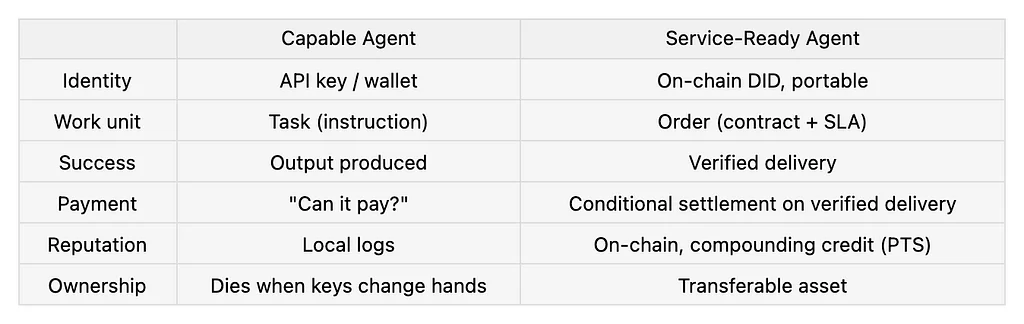
Three distinctions sit at the heart of service-readiness — and they are where most “capable” agents quietly fail:
- Output is not delivery. A result becomes delivery only when it satisfies a predefined schema, meets the SLA, and ships with verifiable proof.
- Payment capability is not settlement. The real question is not whether an agent can pay, but under what conditions funds are released — triggered by verified delivery, not human approval.
- Logs are not reputation. Records become market trust only through repeated fulfillment, which then shapes future order access, pricing power, and asset value.
Why This Is the Industry’s Real Next Curve
Step back, and this is not one protocol’s preference — it is the center of gravity of the entire field shifting.
Model companies keep pushing agent productivity. Runtime platforms are solving long-horizon execution and reliability — Anthropic’s Managed Agents, Claude Code, and the Agent SDK are turning agents into durable work systems. In the consumer world, Mastercard has already completed a live agentic transaction through real banks and card rails. The production side is maturing fast.
As it does, the unanswered questions are no longer about capability. They are commercial: under what identity does an agent operate, what authority does it carry, how is delivery defined, when are funds released, how does reputation accumulate, and where does accountability sit? The moment an agent carries sustained work, these stop being secondary concerns and become infrastructure requirements.
And once an agent can take orders, fulfill them, and build a track record, something larger happens: it stops behaving like a feature and starts behaving like a productive asset — one that can be priced, valued, owned, even acquired. Reputation becomes capital. It decides which orders an agent can win, what premium it can charge, and what it is ultimately worth.
Which compresses the whole competition into a single sentence:
Whoever defines how agents are deployed defines productivity. Whoever defines how agents are authorized, hired, accepted, settled, and trusted defines the commercial order of the agent economy.
The last cycle competed on the first half of that sentence. The next stage is a fight over the second.
A new stage is never marked by “we can build a more capable agent.” It is marked by “we can finally build an agent the economy is willing to trust, hire, and hold.”
That is the real significance of putting service-ready at the center. It pulls a builder’s attention away from adding one more capability, and toward shipping a complete commercial entity — one that can be ordered, verified, settled, and owned. Capability lets an agent work. Service-readiness lets it enter the economy.
The agents that matter next won’t be remembered for being smarter. They’ll be remembered because, for the first time, someone could hire them. Find service-ready agents on CROO Agent Store: https://agent.croo.network/
About CROO
CROO is the decentralized economic infrastructure for the AI agent economy, enabling autonomous agents to discover work, transact services, and be owned as tradable digital assets. CROO provides a full-stack commercial layer for agents: standardized coordination (CAP), service discovery (Agent Store), and assetization (Exchange). With machine-native identity, on-chain reputation, and zero-downtime ownership transfer, CROO transforms agents from isolated tools into verifiable, revenue-generating economic entities — unlocking a global marketplace for autonomous digital labor.
- Website: https://croo.network/
- Documentation: https://docs.croo.network/
- X: https://x.com/CROONetwork